- May 20
You Can Come Back: What Jesus Says to the Believer Who Lost the Fire
- Ernest H. Benjamin
Revelation 2:5–7 | Sunday Renewal | Episode 74
Maybe you're still showing up. Still serving. Still calling Him Lord.
But something has changed. The fire that once made the Word feel like bread, urgent, necessary, alive, has dimmed into obligation. The love that once made worship feel like rushing water now feels like a slow leak. You're faithful in your hands. But your heart is somewhere else.
If that describes you, this message is not for you to feel worse. It's for you to find your way back.
Because Christ is not a doctor who hands you a diagnosis and leaves the room. He gives the prescription. And in Revelation 2:5–7, He speaks three commands, issues one warning, and offers one promise so beautiful it will take your breath away.
A Diagnosis Already Given
Two weeks prior in this series, Christ walked into a church that, by every human measure, looked healthy. The church in Ephesus was hardworking, doctrinally sound, and battle-tested. They had endured. They had discerned false teachers. They had stood firm.
And yet Christ said: "I have this against you: you have abandoned the love you had at first."
Not that they stopped working. Not that they stopped believing. They stopped loving. The engine was still running. The fuel was gone.
For many of us, that diagnosis landed like a stone in still water. We felt the ripples. We knew it was for us. And we've been sitting with it ever since, unsure how to get back. Not sure if we can.
Today, Christ answers that question.
Command One: Remember
"Remember therefore from where you have fallen." — Revelation 2:5a
This is not a gentle nudge toward nostalgia. The word Christ uses carries the force of a military command — to call something to mind actively, deliberately, and hold it there.
Notice He doesn't say remember what you used to do. He says remember from where you have fallen. That word, fallen, describes a collapse. A drop from a height. Christ is saying: you were up, and now you are down. You were close, and now you are far. You were on fire, and now you are cold.
Think about what that fire once looked like. Daily in the Word, not out of discipline, but out of hunger. New believers burning fifty thousand pieces of silver in public because Christ was worth more than everything they owned. Elders weeping on each other's necks because the bonds between them were deeper than blood. An entire city's economy shaking because the gospel would not be silent.
That is where they fell from. Not from bad to worse. From burning devotion to cold duty.
And Christ says: don't normalize the distance. Don't convince yourself that where you are now is where you've always been. You were somewhere else. You were closer. Feel the contrast. Let it break your heart.
Because remembering is not the destination. It's the doorway.
Command Two: Repent
"Repent." — Revelation 2:5b
One word. No qualifier. No softening. No extended negotiation. Just: repent.
Most people hear that word and think it means feel sorry. Sorrow may be involved. But that is not what this word means.
In the original language, repentance means to change your mind so completely that it changes the direction of your life. It is a turn, decisive, deliberate, conscious. From one direction to another.
Paul explains the difference in 2 Corinthians 7:10: "Godly grief produces a repentance that leads to salvation without regret, whereas worldly grief produces death."
Worldly grief says: I feel bad that I got caught. Godly grief says: I am broken over what I've become, and I refuse to stay here. One is emotion without motion. The other produces a turn.
Here is what makes this command so piercing: Christ is not talking to pagans. He is not talking to people who have openly walked away from God. He is talking to the faithful. The hardworking. The doctrinally sound. The ones who showed up and served and endured.
And He says to them: repent.
That means repentance is not just for the person who walked away from God. It is for the person who stayed in the building but left the love.
Repentance is not weakness. It is not an admission that your faithfulness was fraudulent. It is the courage to look at the gap between where you are and where you should be, and refuse to pretend it isn't there. The strongest thing a believer can do is not keep performing. It is to stop, turn around, and come home.
Command Three: Return
"Do the works you did at first." — Revelation 2:5c
This is where people get confused. Christ is not saying try harder. The Ephesian church was already trying hard. Effort was never their problem. Their problem was that the effort had become disconnected from the love.
When Christ says do the works you did at first, He is not talking about the amount of work. He is talking about the kind of work that flows from a heart on fire, not a heart on autopilot.
The difference is everything.
They were in the Word daily, not because they were disciplined, but because they were hungry. They burned their books not because they were instructed to, but because Christ was worth more. They wept over each other not because it was expected, but because the love was real.
Return looks like this: Open the Bible not because you feel like it, but because Christ said to, and come to it the way you came at first. Hungry. Stop performing. Stop hiding. Tell the truth about where you are. James 5:16 — confess your sins to one another and pray for one another, that you may be healed. Healing doesn't come through hiding. It comes through honesty.
Burn what is competing for your devotion. The habit. The grudge. The secret loyalty. The distraction. Don't negotiate with it. Don't manage it. Burn it. Love the body of Christ, not like a building you visit, but like a family you belong to. Reach the lost with urgency, not because you have a program to run, but because people are perishing and you carry the only message that can save them.
Same hands. Different fire. That's the prescription.
The Warning
"If not, I will come to you and remove your lampstand from its place." — Revelation 2:5d
Two words should stop you cold: if not.
Christ has given three commands. And now He says: if you hear this and do nothing, there will be a consequence. And it is not a slap on the wrist. He will remove the lampstand.
The lampstand is the church's identity. Its purpose. Its reason for existing. A lampstand has one function: to bear light. And Christ says...if you refuse to return to your first love, I will take away your capacity to fulfill your purpose.
This is not history. The church in Ephesus eventually disappeared. The city that once trembled at the gospel is now a pile of ruins in modern Turkey. What Christ threatened, He carried out. He does not bluff.
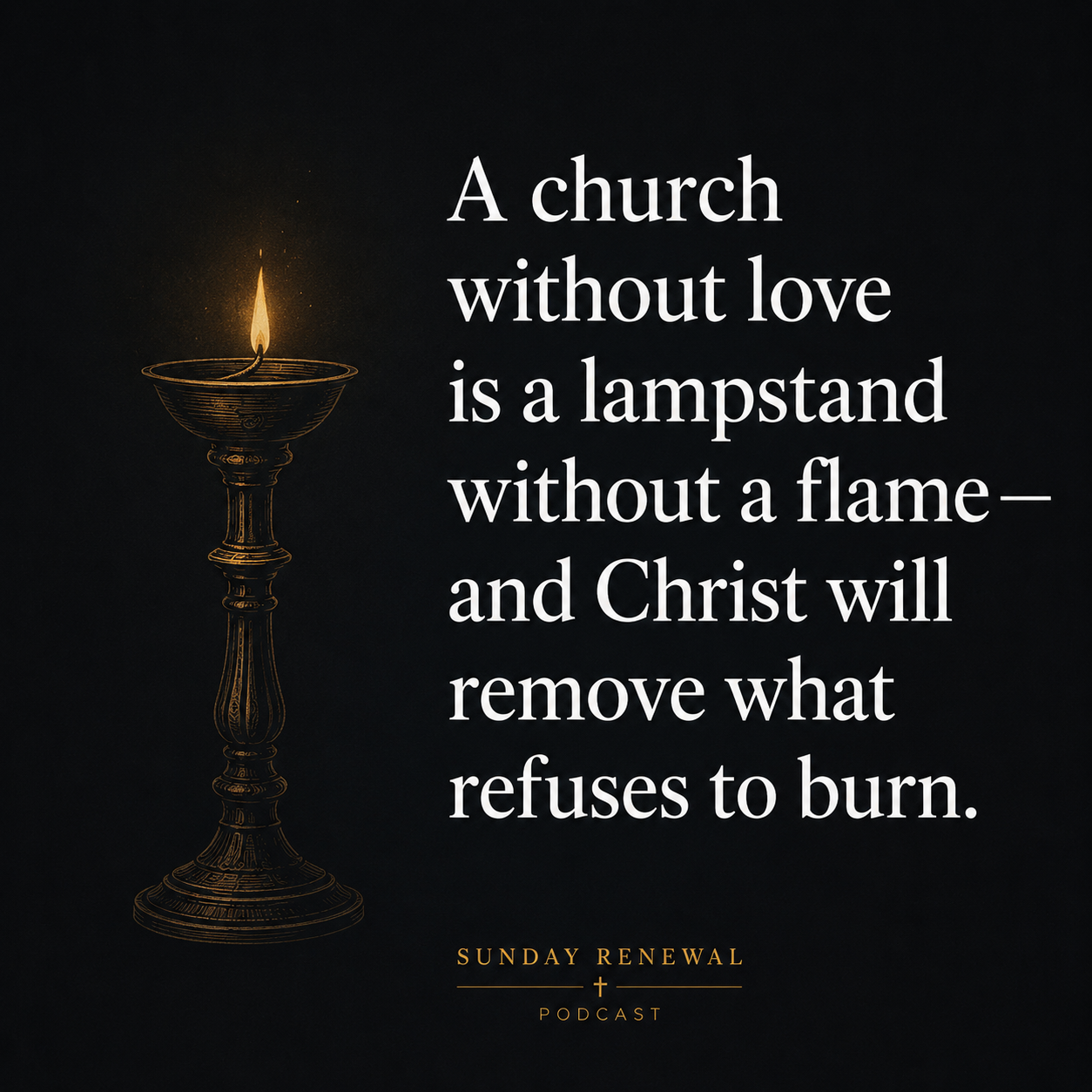
A church without love is a lampstand without a flame. And Christ will remove what refuses to burn.
One Final Commendation
Before the promise, Christ pauses: "Yet this you have: you hate the works of the Nicolaitans, which I also hate."
The Nicolaitans blurred the line between the church and the surrounding culture, encouraging compromise through idolatrous practices and immorality, and called it freedom. The Ephesian church refused. They didn't just disagree. They hated those works. And Christ says: so do I.
This is a reminder the church desperately needs today: love and holiness are not enemies. First love is not soft on sin. It is not sentimental tolerance. It is fierce devotion to Christ that loves what He loves and hates what He hates.
The Promise
"To the one who conquers I will grant to eat of the tree of life, which is in the Paradise of God." — Revelation 2:7
After the diagnosis. After the commands. After the warning. Christ ends with a promise that reaches all the way back to the beginning.
In Genesis 2, the tree of life stood in the middle of the garden, accessible to Adam and Eve, a symbol of unbroken fellowship with God and unending life in His presence. Then sin entered. And in Genesis 3, God drove man out and stationed cherubim with a flaming sword to guard the way to the tree.
For the entire span of human history, from Genesis 3 until this moment, no one has eaten from that tree.
And now Christ says: to the one who conquers, to the one who remembers, repents, and returns, I will grant access to the tree of life in the Paradise of God.
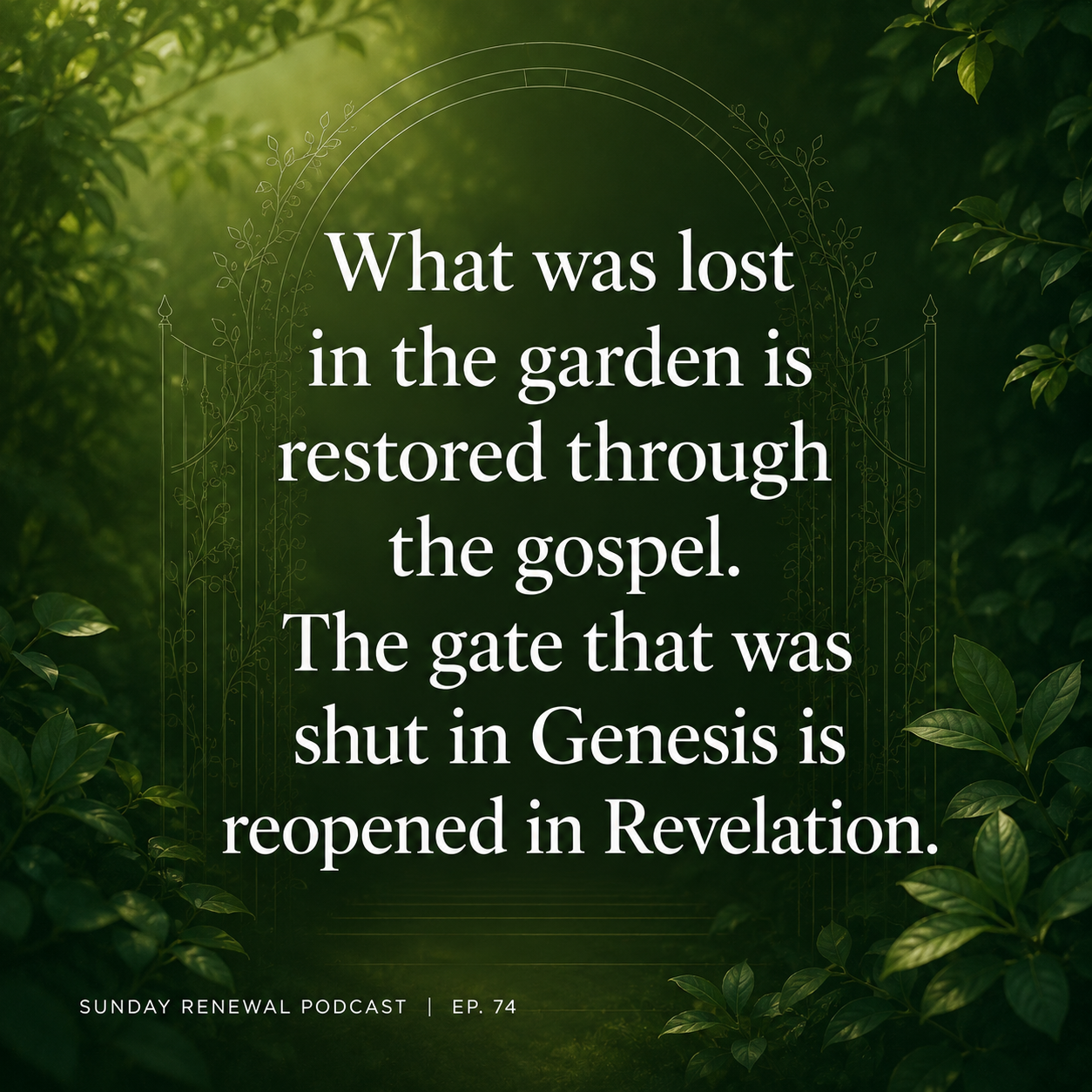
What was lost in the garden is restored through the gospel. What sin took away, Christ gives back. The gate that was shut in Genesis is reopened in Revelation.
On the other side of repentance is not just a better version of your routine. It is full, unbroken, eternal fellowship with God, the thing your soul has been aching for. The thing no earthly pleasure, no achievement, no relationship has ever fully satisfied.
The tree of life is waiting. And Christ Himself, not as a judge holding your failures against you, but as a Savior welcoming you home, is holding out His hand.
One Last Question
Do you still love Him?
If the answer is yes, even if it's a whisper, even if it's buried under years of routine, duty, and distance, you know what to do.
Remember. Repent. Return.
You don't have to stay where you are. You can come back.
Sunday Renewal exists to help you reconnect with God weekly through Scripture, reflection, and prayer. Listen to the podcast at podcast.sundayrenewal.com
Love This Content? Help Us Share More Hope & Faith! 💛
Join Me Weekly:
Subscribe to my blog for fresh devotionals that bring God’s Word to life, listen to the weekly podcast, or follow me: