- Jun 3
Why Some People Love Jesus Deeply (And Others Don't): The Surprising Answer in Luke 7
- Ernest H. Benjamin
Listen to the Full Episode
🎧 Episode 76 — Why Some People Love Jesus Deeply… And Others Don't (Luke 7) Pt. 2
Have you ever noticed it?
Two people. Same church. Same Bible. Same sermons. But one of them loves Jesus in a way that stops you. Their worship isn't a performance. Their faith isn't an obligation. Something in them is undone by Jesus, and you can feel it.
The other person is faithful, knowledgeable, maybe even impressive. But there's a distance. A coolness. A politeness where there should be fire.
What's the difference?
Jesus answers that question at a dinner party in Luke 7. And what he reveals turns the entire room, and every comfortable assumption we carry, upside down.
The Room No One Expected
We're stepping into part two of this story (if you haven't read or heard Part 1 first, start there). But here's what you need to know:
A woman, known in the city as a sinner, has crashed a Pharisee's dinner party. She didn't bring a covered dish. She brought an alabaster flask of expensive perfume and a heart full of things she couldn't say out loud. She found Jesus reclining at the table, fell at his feet, and began to weep. Her tears fell on his feet. She wiped them with her hair. She kissed his feet and poured out the perfume.
Simon, the Pharisee who hosted the dinner, watched all of this from across the table and made his quiet verdict: if this man were really a prophet, he would know what kind of woman this is.
Jesus told a parable about two debtors, one who owed a year and a half of wages, and one who owed two months' wages. Both bankrupt. The lender cancelled both debts freely. Then Jesus asked Simon: which one will love him more?
Simon answered correctly: the one forgiven the larger debt.
Jesus said: You have judged rightly.
And then the parable became a mirror.
"Do You See This Woman?"
Here is the moment everything changes.
"Then, turning toward the woman, he said to Simon, 'Do you see this woman?'" — Luke 7:44
Think about how strange that question sounds. Of course, Simon sees her. She's been at Jesus's feet for what feels like forever, weeping, anointing, kissing. Simon has been watching since she walked in.
But Jesus isn't asking whether Simon's eyes are pointed in her direction.
He's asking: Do you actually see her?
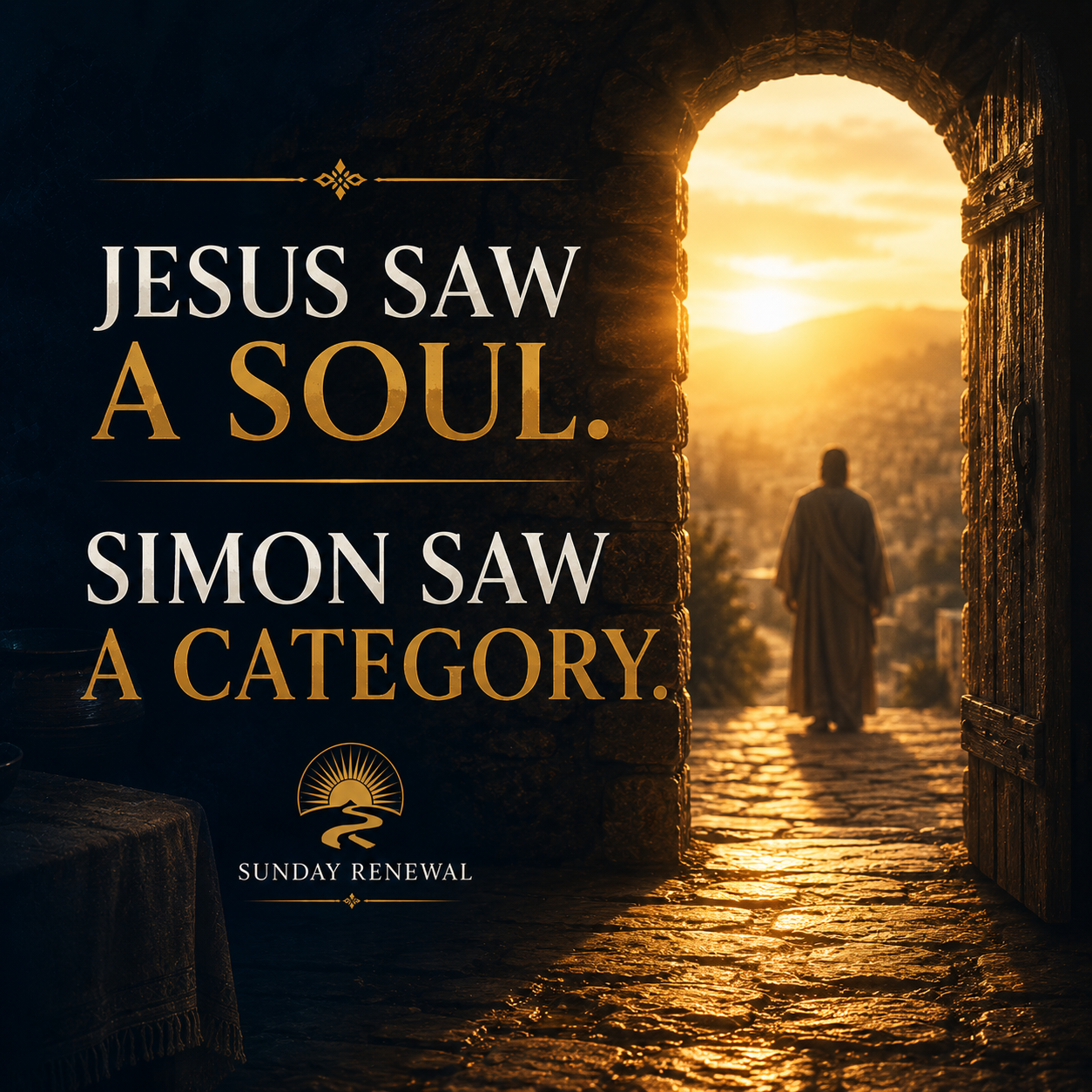
Simon had seen a category. A sinner. A disqualification. A scandal that had interrupted his dinner. He had looked at her and never once considered what Jesus saw: a broken person who had come to the only Savior in the room.
That question lands on all of us.
There are people we encounter every day that we have looked at without actually seeing. The coworker we've categorized. The family member we've written off. The person across the aisle whose past, politics, or choices caused us to disqualify them before we ever knew their name quietly.
Jesus turns toward those people. And while his face is toward them, he speaks to us.
Do you see this person?
The Three Comparisons That Expose Everything
What Jesus does next is devastating, not through accusation, but through contrast.
No water. But she gave tears. In that culture, offering water for a guest's dusty feet was the most basic sign of welcome. To withhold it was a deliberate snub. Simon invited Jesus to dinner and refused him this. The woman, who wasn't even an invited guest, washed Jesus's feet with what Simon wouldn't provide. Not water. Her tears. And she dried them not with a towel, but with her hair. Her glory. Her dignity.
No kiss. But she never stopped kissing. A greeting kiss was the second sign of welcome. Simon offered Jesus nothing. This woman, from the moment she arrived, had not stopped kissing his feet, the lowest point on his body, the place a servant would kiss, not a peer.
No oil. But she poured out everything. A host would pour a drop of inexpensive olive oil on an honored guest's head as a gesture of welcome. Simon didn't bother. The woman poured an entire flask of costly perfume, possibly the most valuable thing she owned, on his feet.
Three times, what Simon withheld in pride, she gave in brokenness.
And here is what Jesus accomplishes: without ever calling Simon a name, without raising his voice, without public humiliation, he has named, item by item, exactly where Simon failed.
The sin Simon thought was invisible has been seen. The Pharisee who walked in convinced he was the smaller debtor, if he even viewed himself as one, has just been shown quietly and unmistakably that his debt is far larger than he realized.

The Most Misread Verse in the Room
"Therefore I tell you, her sins, which are many, are forgiven, for she loved much. But he who is forgiven little, loves little." — Luke 7:47
Read quickly, this sounds like: she loved much, so she was forgiven. Her love earned her forgiveness.
That reading destroys the entire gospel.
Go back to the parable. Neither debtor could pay. Neither debtor cleaned himself up first. The lender cancelled both debts as a free act of mercy — before either debtor loved him. Love came after the cancellation, not before.
The phrase "for she loved much" in the original Greek functions as evidence, not cause. Jesus is saying: you can see that her sins are forgiven because look at how much she loves. Her love is the proof of forgiveness. Not the reason for it.
Here's the image that clarifies it: if you walk outside and see wet pavement, you don't say the pavement caused the rain. The wet pavement is evidence that it rained. Same logic here.
The woman's love didn't purchase her forgiveness. Her forgiveness produced her love.
And the warning embedded in the second half of the verse: he who is forgiven little, loves little. That's not a statement about the size of Simon's sin. It's a statement about how small he had been treating it. His love for Jesus was cold, polite, and distant, not because he owed little, but because he had never let himself feel the weight of what he owed.
And here is the invitation underneath the warning:
You want to love Jesus more? It won't come from trying harder. The path to greater love is greater awareness of grace. See the debt more clearly. See the cancellation more clearly. See the cross more clearly. And the love will rise — the way her tears rose. Without instruction. Without performance. Naturally. Because forgiven people love Jesus differently.

Three Sentences Every Broken Sinner Has Longed to Hear
The exposure was not the end. It was the prelude.
Because Jesus did not turn toward this woman simply to contrast her with Simon, he turned toward her to set her free.
"And he said to her, 'Your sins are forgiven.'" — Luke 7:48
Stop there.
Not: sin is forgivable in general. Not: come back when you've cleaned up, and we'll talk about it. Not: you might be forgiven someday.
Your sins are forgiven. Present tense. Settled. Done. The debt is cancelled. The case is closed. The verdict rendered by the only judge whose verdict actually matters.
And notice: he said to her. Not to the room. Not as a general announcement. Directly. Personally. The forgiveness lands in her ears before it lands anywhere else.
The other guests at the table asked the right question: "Who is this who even forgives sins?"
They understood what the Old Testament made plain... only God can forgive sins in the ultimate sense. The psalmist wrote, "I will confess my transgressions to the Lord, and you forgave the iniquity of my sin" (Psalm 32:5). Isaiah recorded God saying, "I, I am he who blots out your transgressions" (Isaiah 43:25). This authority belongs to God alone.
And Jesus is sitting at a dinner table doing exactly that.
The question — who is this? — is the question every human being must answer. And how you answer it determines everything about eternity.

How Can Jesus Actually Say This?
There's a deeper question beneath the blessing of forgiveness: how does a holy God forgive sin without simply ignoring it?
The Old Testament is clear: God will by no means clear the guilty (Exodus 34:7). Sin must be answered. It cannot be swept aside. If God simply ignored sin, he would no longer be just.
The answer is the cross.
In the parable, the lender cancelled the debt, but the debt didn't vanish into thin air. When a lender cancels a debt, the lender absorbs the loss. Someone pays. The debt just moves.
When Jesus went to the cross, when his back was torn by Roman whips, when nails were driven through his wrists and feet, when the wrath of God for the sins of his people fell on him, he was paying the bill. Absorbing the debt. He was the lender who personally paid the cost of the cancellation.
The woman at his feet did not yet fully know this. But the same Jesus who sent her away forgiven would, in the not-too-distant future, hang on a cross to make her forgiveness possible. Her forgiveness in that dining room was real. The ground of it, a cross that had not yet happened, but in the mind of God was already certain.
Every forgiven sinner, including every one of us, receives forgiveness on that exact same ground. Not because we earned it. Not because we cleaned up enough. Because Jesus Christ stepped into history, lived the life we could not live, and went to the cross to pay the debt we could not pay.
That is the only reason he can say it.
And it is enough because his blood is enough.

Your Faith Has Saved You. Go in Peace.
"And he said to the woman, 'Your faith has saved you; go in peace.'" — Luke 7:50
He does not say: your tears have saved you. He does not say: your love has saved you. He does not say: your ointment has saved you.
Your faith has saved you.
Everything this woman did at his feet, the tears, the kisses, the hair, the expensive perfume, was the fruit of faith, not the cause of her salvation. Faith saved her. Her trust in Jesus. Her belief that he was the kind of Savior who would receive her. Her willingness to risk humiliation because she trusted mercy would be greater than rejection.
For by grace you have been saved through faith, and this is not your own doing; it is the gift of God, not a result of works, so that no one may boast. (Ephesians 2:8–9)
That is the pattern. And it is good news for every one of us because if salvation came through tears, some of us couldn't muster enough. If it came through dramatic emotional displays, some of us have nothing to give. If it came through performance, every one of us would fall short.
But salvation comes through faith. Trust in Christ. Movement toward him.
And then the benediction over a forgiven life:
Go in peace.
She came in with shame. She leaves in peace. She came in unable to lift her head. She leaves with the blessing of the Son of God on her shoulders. She came in carrying years of broken life, ruined reputation, and accumulated sin. She leaves carrying shalom — wholeness, restoration, the deep, settled well-being of a person who is right with God.
The woman who walked into Simon's house fragmented, is walking out whole.
Which Debtor Are You?
The dinner is over. The room is quiet.
Simon is sitting at his own table, exposed, unsettled, perhaps still working through what he has just witnessed. The other guests are still wrestling with the question. And the woman, the woman who walked in with everything against her, gets up.
She is no longer at his feet. Jesus has lifted her. She is no longer weeping. The peace of God has settled over her. She walks out of Simon's house, past the whispers, past the crowd, past every silent judgment that had been spoken over her for years, untouched by Simon's verdict, carried by Christ.
That picture, a forgiven sinner walking out of a room of judgment with peace in her steps, is the gospel. It is what Christ does for every soul who comes to him in faith.
If you are the big debtor — the one whose past has weighed on you for years, the one who came to this with every reason to assume Jesus wouldn't receive you — hear it from his own mouth:
Your sins are forgiven.
Your faith has saved you.
Go in peace.
There is no exception clause.
No fine print.
No qualifying behavior you must produce first.
If you are Simon — the one whose love for Jesus has cooled into routine, who has been able to sit at the table of God for years without being undone or amazed — the path back is not greater effort.
It is greater awareness of grace.
See your debt again.
See your cancellation again.
See the cross again.
Because forgiven people love Jesus differently.
And when you see what has been forgiven...your love will rise again.
Love This Content? Help Us Share More Hope & Faith! 💛
Join Me Weekly:
Subscribe to my blog for fresh devotionals that bring God’s Word to life, listen to the weekly podcast, or follow me: