- Jul 15
Don't Be Hasty: What 1 Timothy 5:22 Teaches Us About Protecting the Church
- Ernest H. Benjamin
There is a question that sits heavy on anyone who has ever watched a church get wounded by a leader who should never have been appointed in the first place: how did this happen?
Not "how did he fail"; people fail, that part is tragically ordinary. The harder question is the one underneath it. Who saw the warning signs and said nothing? Who rushed the process because a position needed filling? Who looked past the red flags because the man was likeable, available, or convenient?
That is the exact question the Apostle Paul forces into the light in 1 Timothy 5:22, the final verse of a muti-part series on the stewardship of church leadership. And in this closing message, we discover that Scripture does not let anyone off the hook — not the man who fails, and not the people who put him there.
The Verse That Ends the Series and Starts the Reckoning
Paul writes to Timothy: "Do not be hasty in the laying on of hands, nor take part in the sins of others." Then, almost as an afterthought that turns out to be the whole point, he adds two final words: "Keep yourself pure."
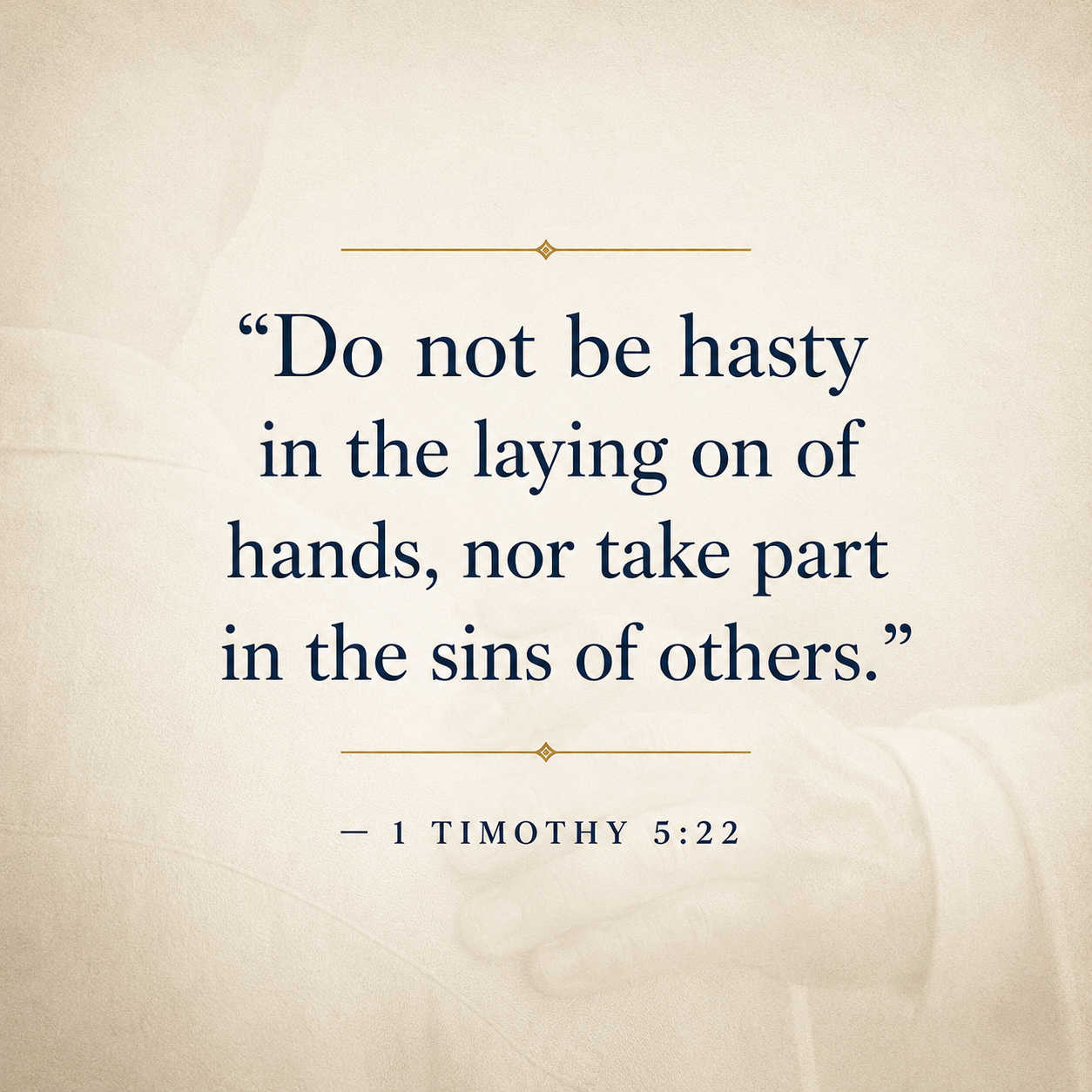
Three commands. Three weights. One verse.
But before we can feel the weight, we have to get the theology exactly right, because it is easy to misread this passage in a way Scripture never intended.
Paul is not saying that Timothy becomes personally guilty of every sin a future elder commits. He is not teaching that one person bears the moral guilt of another person's actions. Scripture is consistent on this from cover to cover. Through the prophet Ezekiel, God declared, "The soul who sins shall die. The righteousness of the righteous shall be upon himself, and the wickedness of the wicked shall be upon himself" (Ezekiel 18:20). Paul himself affirms the same truth in 2 Corinthians 5:10: each of us will stand before the judgment seat of Christ and give an account for what we have done.
So what is Paul actually saying? When a man is entrusted with spiritual authority through careless or hasty evaluation — when warning signs were ignored, when qualifications were never honestly verified, when the appointment was rushed — the people who made that decision share responsibility for the consequences that follow. Not the moral guilt of the sin itself, but the responsibility for placing a man in a position where he could cause the damage he caused.
This is the doctrine of stewardship running straight through Scripture. A steward is answerable for how he handles what has been entrusted to him, and church leadership decisions are not the exception. They are, in fact, one of the heaviest stewardships a congregation will ever carry.
The Pilot Nobody Should Have Hired
Imagine an airline knowingly hiring a pilot who is not qualified to fly the aircraft. The warning signs were there: failed evaluations, witnesses to his recklessness, documentation of his unfitness, and the airline hired him anyway because they needed a pilot and he was available.
If that plane crashes, who bears the responsibility?
The pilot, certainly. He flew the aircraft. He made the decisions in the cockpit. But not only the pilot. The people who put him in that cockpit, knowing or carelessly failing to verify what they should have known, share in the catastrophe. Their responsibility looks different from his, but it's real, and the families of the passengers know it's real.
That is exactly the principle Paul is placing on every eldership, every appointment committee, every congregation with a voice in who gets handed spiritual authority. Some of the failures that have wounded the church most deeply were never surprises. The warning signs were visible to those close enough to see them. The questions had already been raised by people brave enough to raise them. And somewhere in the process, those signs were minimized, those questions were brushed aside, and a man was placed in spiritual authority who, upon honest evaluation, never should have been.
The harm from that decision doesn't always land right away. Sometimes it surfaces months later. Sometimes years. Sometimes decades. And it lands on people who had no part in the original decision at all — wounded members, betrayed families, shaken young believers, a watching community whose view of Christ was damaged by what they saw.
They didn't appoint that leader. But someone did. And Paul says those who did share in what unfolded.
This Is Not a Verse Meant to Terrify Faithful Stewards
Here's where precision matters just as much as conviction. Paul is not laying an impossible burden on leaders who did the hard, honest work of evaluation and still, years later, watched a man drift into sin nobody could have foreseen. There is a real difference between careless stewardship and faithful stewardship that simply could not detect a hidden heart.
The eldership that carefully evaluated a man, that prayerfully affirmed him, that walked through the qualifications honestly and appointed him in good faith, and later watched him fail in ways no reasonable process could have predicted, has not violated this verse.
But the eldership that brushed past warning signs, hurried the process, lowered the standards, and laid hands on a man simply because they wanted him in the position? They share responsibility for what they enabled.
The difference is never the outcome. The difference is the stewardship.
Three Groups, One Weighty Application
To current leaders and appointment bodies: take evaluation with the seriousness it deserves. The standard was never that every decision would be perfect — no elder or eldership can claim that. The standard is faithfulness. Did you ask the hard questions? Weigh the evidence honestly? Refuse to lower the bar under pressure? That is what God will weigh.
To congregations: pray seriously for the leadership decisions being made on your behalf. Your elders are wrestling with hard cases you will never see, under a verse that places real responsibility on how they handle it. Hold them up before God.
To future leaders: understand the weight of the office before you ever step toward it. Spiritual leadership is not a credential, a platform, or a rung on a ladder. It is a transfer of responsibility before God for His people's souls. Pursue the kind of character that makes the stewardship of those appointing you easier, not harder.
Keep Yourself Pure
After six verses of instruction — how to honor faithful leaders, how to handle accusations, how to confront persistent sin, how to act with impartiality, how to appoint future leaders without haste — Paul ends the entire passage on the one man who has to carry it out: "Keep yourself pure."
This is not tucked away as an afterthought. It is the foundation underneath everything else Paul has said. You cannot expect a man to evaluate other men's qualifications carefully if he himself has stopped guarding his own walk. The integrity of the appointment process depends entirely on the integrity of the person running it.
Purity here is broader than any single application; it covers integrity, the quality of being the same man in private that you are in public. It covers impartiality, freedom from compromising loyalties. It covers faithfulness, the unbroken commitment to obey God regardless of cost. And the word "keep" is not a finish line; it is an ongoing discipline. Guard. Maintain. Watch over. Continually preserve.
Picture a compass. A compass must be properly aligned before it can guide anyone else. If the needle has been knocked off true north, everyone who follows it will be led off course, no matter how confidently it points. The compass cannot give what it does not itself possess.

The same is true for anyone entrusted with leading Christ's church. A man whose own heart is not aligned with God cannot reliably point others toward Him. He may say the right words, go through the right motions, even make some decisions that turn out fine. But over time, the compromise of his own walk will produce drift in the decisions he makes, and the people he was supposed to guide will be led away from where they were meant to go.
No man becomes pure on the day of his appointment. He becomes pure, or he fails to, in the years of formation that came before it. The disciplines built in obscurity are what hold up under the weight of leadership later.
The One Leader Who Never Failed
By the end of several weeks walking through this passage, none of us should be standing here feeling proud of our own faithfulness. Every elder has fallen short of perfect impartiality somewhere. Every preacher has wrestled with self-interest. Every man who has ever laid hands on another has, at some point, looked back and wondered if he handled it with the wisdom God required.
There is only one leader in history who carried the full weight of every command Paul gave Timothy and never failed. Before Jesus appointed His twelve apostles, He went up a mountain and prayed all night (Luke 6:12-13). He was not hasty. He did not rush.
And yes, that twelve included Judas. But Jesus said plainly, "Did I not choose you, the twelve? And yet one of you is a devil" (John 6:70). He knew exactly who Judas was when He chose him. That was not a failure of discernment; it was sovereignty woven into a redemptive plan human eyes could never have seen coming because the cross itself, and the salvation of everyone who has ever trusted Christ, depended on it.
We cannot see twenty years down the road the way Christ can. That is precisely why Paul tells Timothy to be patient and careful, because Timothy is not Jesus. But Christ is not bound by our limitations. He sees every heart. And even the worst leadership failure in human history did not derail His plan. He used it to save us.
That is the Shepherd this entire series has pointed toward, the chief Shepherd who provides faithful under-shepherds, the righteous judge before whom every leadership decision is weighed, and the perfect King who did flawlessly every single thing Paul commanded Timothy to do. And He did not stop at modeling the standard. He carried the weight of every failure to meet it, bearing it in His own body on the cross, "that we might die to sin and live to righteousness. By his wounds you have been healed" (1 Peter 2:24).
The Church Belongs to Christ
The church does not belong to its elders, its preachers, its longest-tenured families, or its largest donors. It belongs to Christ. He purchased it with His own blood. He governs it with perfect wisdom. And He shepherds it with a patient love that never once ran out, not even when the men entrusted with His flock let Him down.
Honor without accountability produces corruption. Accountability without honor produces suspicion. Leadership selection without discernment produces future problems the church will carry for years. Christ designed His church to need all three — honor, accountability, and discernment — held together, not chosen at the expense of one another.
If you carry any voice in appointing leaders, take that stewardship seriously. If you are under the care of leaders, pray for their private walk with God, not just their public performance. And if you have never personally come to the Christ this entire series has pointed toward, He is calling you even now. Not because you have it all figured out. Not because your trust in leaders, or in the church, has never been broken. But because the chief Shepherd of your soul has been waiting for you to return.
This post is part of the Sunday Renewal series: The Stewardship of Church Leadership.
Ernest Benjamin is the host of Sunday Renewal, a podcast and discipleship ministry helping spiritually exhausted believers reconnect with God through biblical truth, emotional honesty, and gospel-centered transformation. New episodes release every Sunday. Subscribe on Apple Podcasts, Spotify, or YouTube.
Before you go, if you're in a season of spiritual exhaustion, discouragement, or searching for a fresh start, the free 5-day audio devotional Renaming Your Story: From Pain to Purpose to Legacy was created for exactly where you are.
Love This Content? Help Us Share More Hope & Faith! 💛
Join Me Weekly:
Subscribe to my blog for fresh devotionals that bring God’s Word to life, listen to the weekly podcast, or follow me: