- Jul 22
The Difference the Gospel Makes: 6 Real Ways Faith Changes Your Life
- Ernest H. Benjamin
Think about everything you've learned in your life that you never actually use.
The periodic table. The different types of clouds. The Pythagorean theorem. Long division. All the state capitals. Somewhere along the way, most of us quietly filed that information away as "nice to know, but not really necessary." It doesn't shape how we live.

Here's the uncomfortable question guest speaker Hiram Kemp raises in Episode 83 of Sunday Renewal: what if we've done the same thing with the gospel?
What if we believe the death, burial, and resurrection of Jesus actually happened, we've even obeyed the gospel and become Christians, but somewhere along the way, we put it on the same shelf as the periodic table? Useful someday, maybe on the Day of Judgment. But not something that touches the way we actually live right now.
Preaching from the book of Philemon, Kemp makes the case that the gospel was never meant to stay theoretical. It's designed to reach into the way we love people, the way we approach people, the way we deal with what's broken between us — and to saturate all of it with grace.
Philemon is easy to overlook. It's one chapter. Twenty-five verses. No sweeping theology of salvation, no extended teaching on the church. But that's exactly what makes it so powerful. It's real. It's earthy. It's even uncomfortable at points. And it exists in the New Testament to answer one question: what does the gospel actually do to a person?
The Story Behind the Letter
Three people anchor this letter. Philemon is a member of the church in Colossae and a slave owner. Onesimus is the slave who belonged to him. And Paul is the apostle who was mentor and friend to them both.
Onesimus somehow made his way to Paul, who was in prison, and there Paul led him to Christ. Now Paul is sending him back — not as property, but as a letter-carrying brother — with a request. Actually, two requests: that Philemon receive Onesimus as a brother, and that he release him. Paul even offers to repay any debt Onesimus owes personally.
It would be easy to read this as an ancient reconciliation story, disconnected from our lives. Kemp says that's the wrong way to read it. Philemon was written to show twenty-first-century believers exactly what kind of difference the gospel is supposed to make. Here are six of them.
1. The Gospel Produces Real Love
Before Paul ever asks Philemon for anything, he spends seven verses describing what the gospel has already produced in him — fellow laborers in the gospel, a church that meets in his house, a fellow soldier, a man Paul prays for constantly, a man whose life has "refreshed the hearts of the saints."
Our culture has a dozen categories for love...puppy love, tough love, true love, unconditional love. Kemp points out that the New Testament doesn't bother with the distinctions. It just calls it love, and it defines it by action, not sentiment. As Jesus said in John 13:34-35, "A new commandment I give to you, that you love one another. By this will all people know you're my disciples, if you have love one toward another."
That's why Paul can say something as staggering as this about a runaway slave:
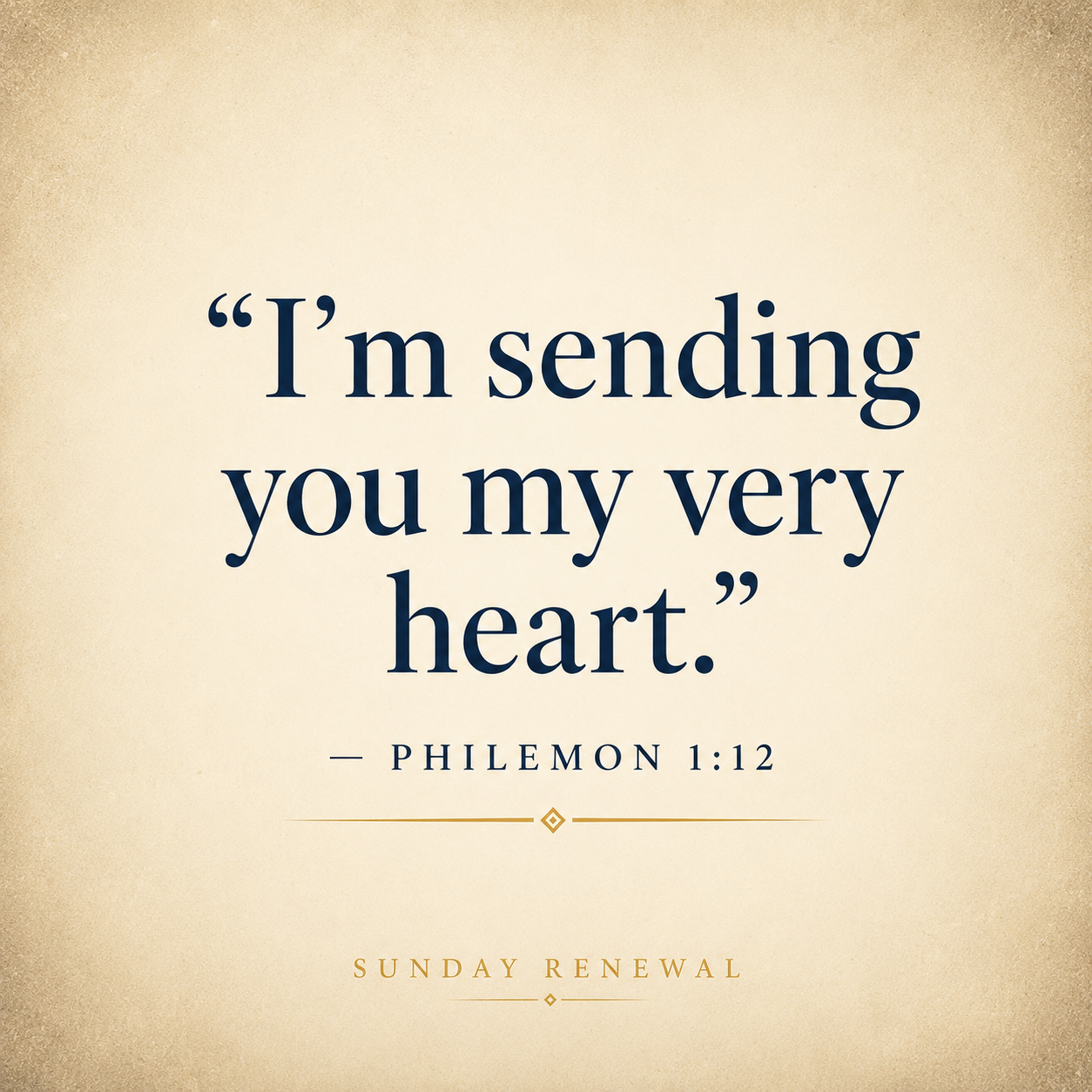
"I'm sending you my very heart."
Not just a brother in Christ. Not just a fellow church member. His very heart. That's what real gospel-love sounds like when it isn't theoretical.
2. The Gospel Changes How You Approach People
Paul had apostolic authority. He could have commanded Philemon outright. Instead, he says he'd rather appeal to him in love. Kemp describes this as the difference between two ways every one of us engages with people: the courtroom approach —gathering evidence, building your case, making sure everyone knows you're right —and the living room approach—sitting down, lowering your voice, listening before you speak.
"Some of us are great lawyers, but we're terrible neighbors."

Paul had every right to use the courtroom. He chose the living room. And Kemp points to Jesus as the ultimate example; He could have called twelve legions of angels to His own defense, but instead prayed from the cross, "Father, forgive them, for they know not what they do." If that's how you were approached, it makes no sense to spend your life approaching everyone else through the courtroom.
3. The Gospel Changes Your Past
Onesimus's name literally means "useful." Paul says he was once "useless" but is "now useful both to you and me in the Lord." Something happened to his identity, not just his behavior.
Kemp illustrates this with a modern picture — the AI "magic eraser" tool that removes photobombers from a picture and fills in the gap as if they were never there. The final photo doesn't pretend the moment didn't happen. It simply doesn't show it anymore.
"The gospel is God's ultimate eraser."

That's not a metaphor for Kemp; he's careful to say the Bible doesn't describe conversion as becoming like a new creature. You are one. Which means:
"You don't have to keep going back to the past to try to fix your mistakes, because God's already forgiven it."
4. The Gospel Fixes Broken Relationships
This is the heart of the letter. Paul isn't just asking Philemon to tolerate Onesimus; he's commanding him to "receive him, just like you would me." The preaching of the gospel, Kemp notes, is literally called "the ministry of reconciliation" in 2 Corinthians 5. If the gospel reconciled you to God, it obligates you to reconcile with people.
Kemp draws a sharp distinction between two kinds of cleaning: the "rush clean," where unexpected company is coming and you just shove everything into a drawer so it looks fine, and the "real clean," where you actually deal with what needs to go. Too many Christians, he says, only ever rush-clean their relationships. They avoid the hard conversation, or they stuff it down, and call that peace.
If the gospel has actually changed you, it won't let you do that. It gives you the wherewithal to face what's broken instead of hiding from it.
5. The Gospel Empowers You to Do Hard Things
Paul is asking Philemon to do one of the hardest things he'll ever do: release a slave, in a culture where that simply wasn't done, and call him brother instead. Paul even puts his own name on the line: "If he owes you anything... I will repay it."
"It changes you so that you don't just say, I love you with your lips, but you learn to say it with your life."
For some people that means forgiving a deep wound. For others, it's letting go of a sin that feels stitched into their skin. For others, it's admitting they can't do life in their own strength. Kemp's point is simple: the gospel doesn't just tell you what's right. It gives you the power to actually do it.

6. The Gospel Saturates Everything With Grace
Paul opens the letter mentioning grace, and he closes it the same way:
"The grace of our Lord Jesus Christ be with your spirit."
Grace isn't only what starts your salvation; it's what sustains you through everything the gospel then asks of you. Kemp imagines Philemon reading this letter, thinking there's no way he can forgive Onesimus for what he's done, and then landing on that last line, and remembering that God had every reason to say the same thing about him, and didn't.

So, What Difference Is It Actually Making?
Kemp's challenge lands squarely on every listener: it's tempting to treat Christianity like a shelf of spiritual trivia — true, but not exactly useful on a Tuesday afternoon. Philemon says otherwise. The gospel was never meant to sit on a shelf. It was meant to reshape how you love, how you approach people, how you see your past, how you handle what's broken, what you're capable of, and what covers you when you fail.
The real question isn't whether you believe the gospel happened. It's whether it's making a difference. Ask yourself the way Kemp asks it: Is it producing real love in me? Am I in the living room or the courtroom with the people in my life? Does my past still control me, or has God already erased it? Is there a relationship I've rush-cleaned instead of really fixed? And when it's hard, is grace the thing I'm actually leaning on?
The gospel was never meant to be theoretical. It was meant to be lived.

Ernest Benjamin is the host of Sunday Renewal, a podcast and discipleship ministry helping spiritually exhausted believers reconnect with God through biblical truth, emotional honesty, and gospel-centered transformation. New episodes release every Sunday. Subscribe on Apple Podcasts, Spotify, or YouTube.
Before you go, if you're in a season of spiritual exhaustion, discouragement, or searching for a fresh start, the free 5-day audio devotional Renaming Your Story: From Pain to Purpose to Legacy was created for exactly where you are.
Love This Content? Help Us Share More Hope & Faith! 💛
Join Me Weekly:
Subscribe to my blog for fresh devotionals that bring God’s Word to life, listen to the weekly podcast, or follow me: