- Jul 29
When the Brook Dries Up: Trusting God When His Provision Changes (1 Kings 17)
- Ernest H. Benjamin
When the Brook Dries Up: Trusting God in Changing Circumstances
Most of us, if we've lived long enough, have walked through a season where something we depended on began to slip away. A job that gave us stability. A relationship that gave us belonging. A season of health, or peace, or certainty about the future — a stretch of life where the brook was flowing and everything felt secure.
And then, slowly or suddenly, the brook began to dry up.
In that season, there's one thing every honest believer eventually discovers: how much confidence we had quietly placed in the thing that was changing. It's easy to say, "I trust God," when the brook is full. It's much harder to say it when the brook is drying up.
That's the question sitting at the center of 1 Kings 17; one of the most honest chapters in the Old Testament about what it actually feels like to trust God when life gets hard. It's where we meet the prophet Elijah, long before he ever stands on Mount Carmel. Before Elijah performs a single public miracle, God takes him somewhere private, a hidden valley, a brook called Cherith. And there, God teaches him a lesson every believer has to learn eventually: the brook will sometimes change, but the God who provides through it never does.
If you're standing beside a drying brook today, or if you still remember what that felt like, this one is for you.
A Declaration Against a Dead God
To understand what's happening at Cherith, you have to understand what's happening in Israel. King Ahab is on the throne, and he has led the nation deeper into idolatry than any king before him, building on the false worship system Jeroboam had established generations earlier, then adding Baal and Asherah worship on top of it. Scripture doesn't soften the assessment: "Ahab did more to provoke the Lord, the God of Israel, to anger than all the kings of Israel who were before him" (1 Kings 16:33).
The Canaanites believed Baal controlled the rain, the thunder, and the fertility of the land. That detail matters, because into that exact lie steps a prophet nobody in Israel has ever heard of.
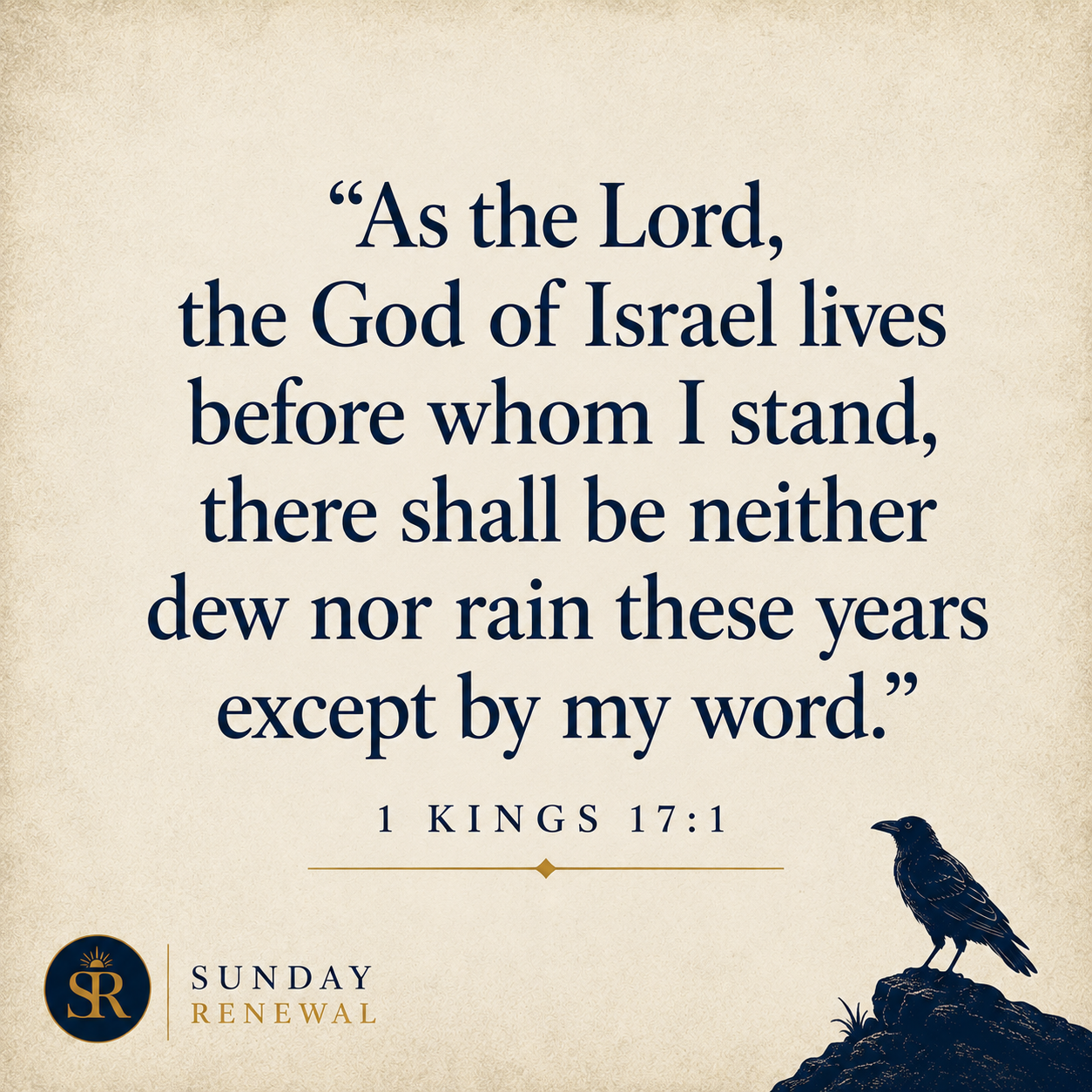
"As the Lord, the God of Israel lives before whom I stand, there shall be neither dew nor rain these years except by my word." (1 Kings 17:1)
This isn't a casual prediction. It's a declaration of war, not against Ahab, not even against Jezebel, but against Baal himself, and against the lie that there is any God in heaven or earth besides the Lord. Baal was supposed to be the god of life, the god who sent the rain. Elijah stands in front of the king who institutionalized that worship and says, in effect: the god you have abandoned is the only living God. The god you have chosen was never alive at all.
Faithfulness Isn't Measured by Blessing
Here's where this passage rearranges how a lot of us think about God's faithfulness. Most of us, if we're honest, define it by what He gives us. When the job comes through, God is faithful. When the diagnosis is good, God is faithful. When the bank account is healthy — Lord, have mercy — God is faithful.
But the Bible teaches something most modern Christians have stopped saying out loud: God's faithfulness is not measured by His blessings. God's faithfulness is measured by His consistency to His Word, and His word includes blessings and curses, promises and warnings.
The inspired writer of Kings makes sure we don't miss this. Right before Elijah appears, we're told about a man named Hiel of Bethel, who rebuilt the city of Jericho — a city Joshua had cursed centuries earlier, declaring that whoever rebuilt it would do so "at the cost of his firstborn... and at the cost of his youngest son" (Joshua 6:26). Hiel rebuilds it anyway. His firstborn dies when the foundation is laid. His youngest dies when the gates are set. Scripture records it plainly: "according to the word of the Lord, which he spoke by Joshua" (1 Kings 16:34).
That verse is placed there on purpose, right before Elijah's drought announcement, to make a single point: God's word does not fail. Not centuries later. Not when people forget it. Not when people defy it. And the warning behind Elijah's drought goes back even further than Jericho, to Moses himself, who told Israel exactly what would happen if they turned to other gods: "The Lord's anger will burn against you. He will shut up the sky and hold back the rain" (Deuteronomy 11:16–17).
So when the sky shuts and the rain stops in 1 Kings 17, it isn't a surprise, an overreaction, or God being harsh. The drought is not the absence of God's faithfulness. The drought is the evidence of it.
Why God Removes Instead of Gives
That raises a harder question. Is God being cruel? Arbitrary? Punishing people who deserve better?
No. He's doing something deeper. As long as the rain kept falling, Israel could keep pretending Baal was working. As long as life kept functioning, Israel could keep believing that worshiping the wrong god didn't matter. So God shuts up the heavens...not because He hates His people, but because He loves them too much to let them die trusting a lie. The drought is an act of mercy. It's God removing the cover that had been hiding the truth.
Sometimes God's faithfulness is revealed not by what He gives, but by what He removes.
That's a hard sentence, because it means the dry seasons in our lives aren't proof that God has stopped loving us. They may be proof that He loves us too much to let us keep trusting something that was never meant to hold us.
So ask yourself honestly: what have you been trusting to give you what only God can give? Maybe it's a job, the security of a steady paycheck. Maybe it's your health, or a relationship, or your sense of control, or your reputation. The form changes from generation to generation. The tendency does not. And if you've lived long enough, you've probably watched God allow one of those things to dry up... not because He stopped loving you, but because He loved you too much to let you keep trusting it instead of Him.
Hidden Before He Was Used
Elijah's confrontation with Ahab is public, the most visible position in the entire nation. And the very next thing God tells him is: hide yourself.
Not "announce more prophecies." Not "build a public ministry." Hide. The prophet fire on Mount Carmel, the defeat of the prophets of Baal...that's all still ahead. But before God uses Elijah publicly, God forms him privately. Kerith before Carmel. Hiddenness before visibility.
And Elijah's response is striking in its simplicity: "So he went and did according to the word of the Lord" (1 Kings 17:5). No arguing. No hesitation. No asking why. He went. He lived where God told him to live. It's the exact same phrase used of Hiel just a few verses earlier, but with the opposite result. Hiel disregarded God's word and lost his sons. Elijah obeyed it and lived.
Fed by an Unclean Bird
God could have provided for Elijah in any number of ordinary ways. Instead, He commanded ravens — birds explicitly classified as unclean in the Law of Moses, scavengers no Israelite would have expected to deliver food. Twice a day, bread and meat. Not a feast. Not scraps. What was enough, and what was certain.
"You shall drink from the brook, and I have commanded the ravens to feed you there." (1 Kings 17:4)
Every morning, Elijah's only assurance that he would eat was the word of the Lord. He couldn't summon the ravens. He had no influence over them. But God's goal was never merely to feed Elijah. God's goal was to form Elijah. The food mattered — his body needed bread, the brook quenched his thirst — but the deeper work wasn't happening in his stomach. It was happening in his heart. The prophet who would later call down fire from heaven first had to learn that his very next meal depended entirely on the Lord's word and faithfulness.
God is often doing something in us while He is doing something for us.
The Sentence That Changes Everything
After all that build-up, the confrontation, the drought announcement, the hiding, the ravens, the daily bread, the inspired writer gives us one quiet sentence:
"And after a while, the brook dried up, because there was no rain in the land." (1 Kings 17:7)
It's easy to read that as unexpected, as a disruption of God's provision. But look at the second half of the verse: the brook dried up because there was no rain in the land — the exact drought God announced in verse one. The drying brook isn't the breakdown of the system. It's the system working exactly as God said it would.
And this is the moment that actually tests faith. When the brook is flowing, trusting God is easy. When the provision is steady, dependence isn't really being tested. But when the brook begins to dry up, every honest believer faces the same question Elijah faced: Was I trusting the brook, or was I trusting the God who sent me to it?
Many of us, if we're honest, discover at the drying brook that we'd begun trusting the provision more than the Provider. We were grateful for the brook, but somewhere along the way, the brook became the thing we depended on. And when it starts to slip away, it feels like the ground is moving under our feet. Not because God has changed, but because we had quietly transferred our trust from Him to His gifts.
Trust the provider more than the provision. Trust the giver more than the gift.

The Giver Never Changes
The job that sustained you was a gift, but the Lord was the Giver. The relationship that anchored you was a gift, but the Lord was the Giver. The season of certainty, the years of stability, the chapter of life that felt secure — all of it was a gift. But the Lord was the Giver. And when those brooks dry up, as they sometimes do, the gift may be changing, but the giver never does.
That reliability reaches its highest proof at the cross. For centuries, God promised a Savior, and "in the fullness of time" (Galatians 4:4), He did exactly what He said He would do. Jesus lived the life the prophets described, died the death Scripture predicted, and on the third day, exactly when He said, He rose. If God kept His word about His Son, crucified, buried, and raised, then God will keep His word about everything else He has promised His people.
So whatever brook is drying up in your life right now, hear it plainly: the God who could be trusted at the empty tomb can be trusted beside your drying brook. Trust the provider more than the provision. Trust the giver more than the gift. He has not gone silent, and He has not changed.
Ernest Benjamin is the host of Sunday Renewal, a podcast and discipleship ministry helping spiritually exhausted believers reconnect with God through biblical truth, emotional honesty, and gospel-centered transformation. New episodes release every Sunday. Subscribe on Apple Podcasts, Spotify, or YouTube.
Before you go, if you're in a season of spiritual exhaustion, discouragement, or searching for a fresh start, the free 5-day audio devotional Renaming Your Story: From Pain to Purpose to Legacy was created for exactly where you are.
Love This Content? Help Us Share More Hope & Faith! 💛
Join Me Weekly:
Subscribe to my blog for fresh devotionals that bring God’s Word to life, listen to the weekly podcast, or follow me: