- Jun 24
When Leaders Are Accused: What God Actually Says About Church Accountability
- Ernest Benjamin
1 Timothy 5:19–21 | The Stewardship of Church Leadership, Week 2
Few things wound a congregation more deeply than watching leadership fail.
But here's what most people don't say out loud: leadership failure isn't the only danger a church faces.
Sometimes churches destroy leaders through gossip, through unverified claims, and through rumors that spread faster than anyone pauses to ask whether it's true. And sometimes churches protect leaders through favoritism, through procedural cowardice, and through the quiet institutional habit of looking the other way when a pattern of sin is hiding in plain sight.
Both errors are devastating. One tears down faithful shepherds. The other allows unrepentant leaders to continue harming the very people they were called to serve.
So how does God want His church to handle this?
When should an accusation be believed? When should it be dismissed? When does silence protect — and when does silence become complicity?
In 1 Timothy 5:19–21, the Apostle Paul answers every one of those questions. And his answer is remarkably, almost uncomfortably, balanced.
The Order of Paul's Words Is Not Accidental
Before Paul says a single word about confronting sin, before he raises the idea of public rebuke, before he addresses what happens when a leader's failure is confirmed, he builds a guardrail against false accusation.
"Do not admit a charge against an elder except on the evidence of two or three witnesses."
— 1 Timothy 5:19 (ESV)
That order matters.
Paul insists that the church establish truth before it acts. The word translated "admit" means to receive, to entertain, to give credence to. Paul is telling the church: do not even receive a charge against a leader as something to be acted upon unless it comes with verified, substantiated, multi-witness evidence.
That is a high bar. And it is deliberately so.
This is not a new standard Paul invented. It goes all the way back to the law of Moses:
"A single witness shall not suffice against a person for any crime or for any wrong in connection with any offense that he has committed. Only on the evidence of two witnesses or of three witnesses shall a charge be established."
— Deuteronomy 19:15 (ESV)
Jesus invoked the same standard in Matthew 18:16. Paul reaffirmed it again in 2 Corinthians 13:1. The principle is ancient, consistent, and deliberate: God's people pursue truth before conclusions.
Why Leaders Are Especially Vulnerable to Accusation
Faithful elders carry weight that most of the congregation never sees. They make decisions that affect people. They preach truth that not everyone wants to hear. They confront sin. They guard doctrine through difficult seasons and through difficult people.
That visibility makes them targets.
Leaders attract criticism. They attract misunderstanding. They attract hostility, sometimes from people who oppose the truth they preach, sometimes from people who resent the correction they've received, and sometimes from people whose grievances have nothing to do with the leader's actual conduct.
Without a biblical standard for handling accusations, accusations become weapons. Rumor becomes ammunition. Personal frustration finds a pulpit.
And good shepherds, faithful men whom Christ Himself has provided for His church, can be destroyed by claims that were never tested, never confirmed, and in some cases, never true.
What Biblical Accountability Is Not
Imagine a courtroom where the judge convicts based solely on hallway whispers. Where one voice, however emotional, however widely repeated, is enough to destroy a person's reputation, their calling, their entire life of service.
None of us would call that justice.
We would call it mob rule.
And yet, we have to be honest here, churches can operate exactly this way.
A rumor circulates. An accusation is repeated. The story grows. And before anyone has investigated, before anyone has spoken with the accused, before the other side has been heard, the verdict has already been rendered in living rooms, in text threads, in hallway conversations before Sunday service.
God's wisdom literature is unsparing about this:
"Spouting off before listening to the facts is both shameful and foolish."
— Proverbs 18:13 (NLT)
"The first to speak in court sounds right — until the cross-examination begins."
— Proverbs 18:17 (NLT)
God does not call this "concern." He calls it shameful. He calls it foolish.
Every time we repeat what we have not verified, every time we render a verdict in our hearts before the other side has been heard, we are not protecting the church. We are damaging it. We are doing the very thing God's own wisdom literature names as sin.

But the Standard Cuts Both Ways
Here is where this passage demands something from all of us.
Because some people are reading this right now who hear Paul's two-or-three-witnesses standard and feel something other than relief. They feel frustrated. Maybe grief. Maybe a familiar, heavy exhaustion.
Some of you have lived through situations where a real pattern of sin existed. Where multiple people had genuine concerns. Where the evidence was actually there. And a church, or a leadership structure, used procedural language not to establish the truth, but to avoid it. They hid behind "we need more witnesses" while harm continued. Protected position over people.
You need to hear this clearly: Paul's standard is a guardrail for justice. It is not a shield for the guilty.
The two-or-three-witnesses standard exists because God values truth. It exists to protect the innocent from being destroyed by rumor. And it exists, equally, to ensure that when sin is present, it can be confirmed and then addressed.
The standard does not tell the church to ignore real evidence. It tells the church to require real evidence. And when that evidence exists — when the witnesses are there, when the charge is established — Paul is not silent about what comes next. He has more to say. A hard and courageous word that those who weaponize procedural delay will not want to hear.
That word is coming in the next episode.
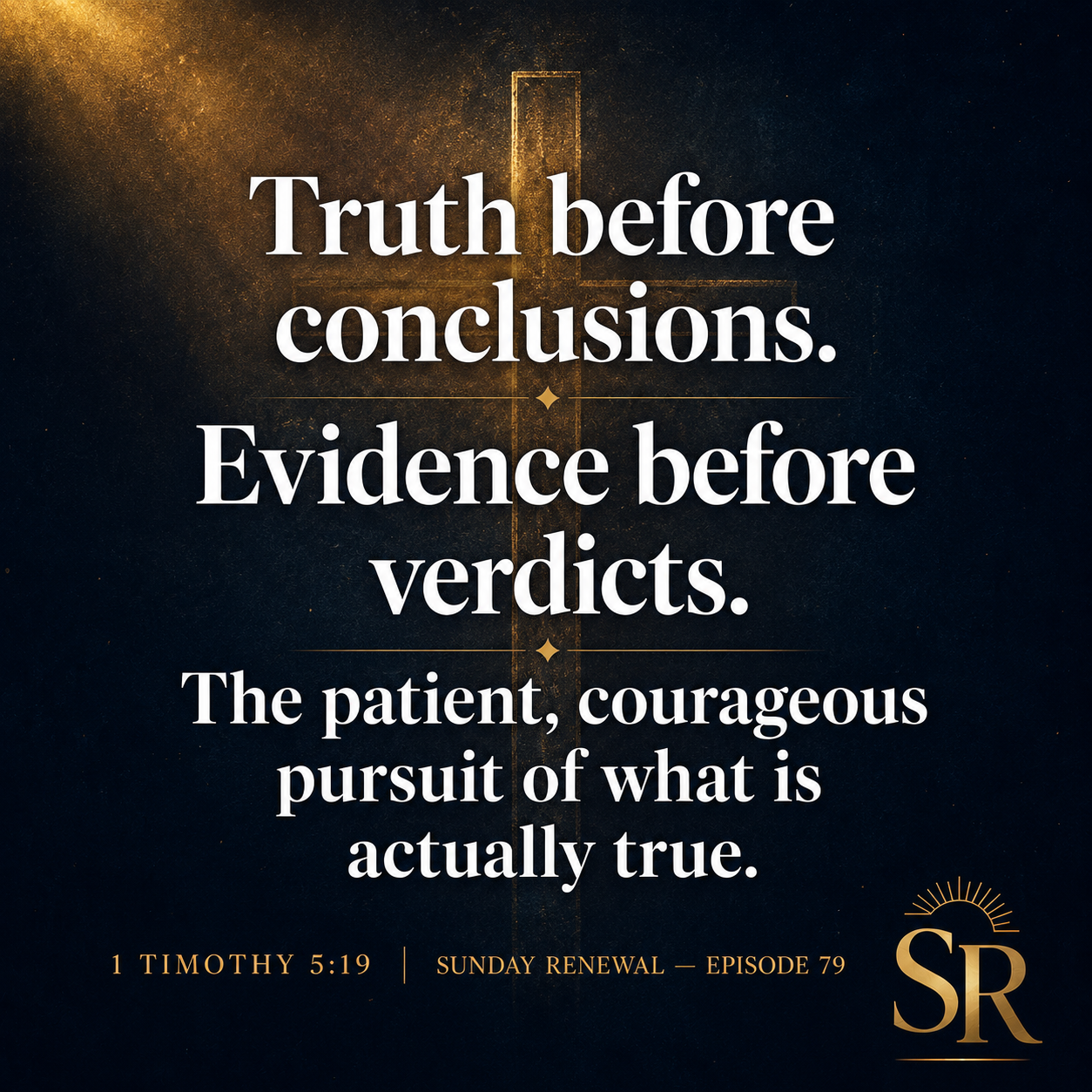
But the foundation is laid here: truth before conclusions. Always.
What This Passage Asks of Each of Us
Paul's teaching in verse 19 doesn't stay in the abstract. It comes to rest on specific people in specific situations.
To the person who repeats stories without verifying them: Stop. Whether you're talking about your elder, your preacher, your Bible class teacher, or any leader who serves your congregation, stop repeating what you cannot establish. Stop participating in the destruction of reputations through rumor. That is not what God's people do. That is the opposite of what God's people do.
To the person who has been on the receiving end of false accusations: God sees. The standard established in Deuteronomy and reaffirmed by Paul is designed to protect you. A church that acts on rumor without confirmation is operating outside of God's design. And the God who established this standard is not silent about its violation.
To the person carrying legitimate concerns that have never been properly heard: Paul is not asking you to bury what you know. He is telling you to bring it through the right channels, with the right witnesses, in the right way. The truth deserves to be established, not suppressed or weaponized.
The Deeper Reality Underneath Every Accusation
There is something Paul wants us to hold in view as we navigate every difficult leadership situation in the church.
Every accusation, every investigation, every act of accountability is ultimately being weighed by One who never abused authority. By One who never required rebuke. By One who Himself bore the judgment that sinners deserved.
Christ is the righteous Judge. This is His church. And every time His people handle leadership accountability the way He designed, carefully, truthfully, impartially, with the fear of God, they are stewarding something that belongs to Him.
The goal was never to protect an institution. It was never to protect a title, a reputation, or a structure. The goal, as it has always been in God's design, is to protect the people, the sheep, entrusted to under-shepherds who themselves answer to the Chief Shepherd.
When we pursue truth before conclusions, when we refuse to weaponize accusation, when we refuse to ignore substantiated sin, we are doing something that goes far beyond church politics or congregational policy.
We are saying, in practice, that Christ is Lord of His church.
That is the stewardship He is calling us to.
What's Coming Next
If verse 19 guards against false accusation, verse 20 refuses to let confirmed sin hide behind procedural silence. Paul has a hard, courageous, and deeply protective word for what happens when the evidence is in, the witnesses have spoken, and the truth is no longer a question.
We will walk through it together next week.
Until then, let this anchor you:
God does not ask His church to believe every accusation. He asks His church to pursue the truth.
And justice, real, biblical, Christ-honoring justice, always begins exactly where God said it begins. With witnesses. With evidence. With the patient, careful, courageous pursuit of what is actually true.
May God give us the wisdom to be a people who handle His church the way He has commanded.
This is Week 2 of The Stewardship of Church Leadership — a multi-part series on 1 Timothy 5:17–21. Listen to the full episode on Apple Podcasts, Spotify, or wherever you get your podcasts. And if today's message helped you, share it with someone who leads or someone who follows.
Love This Content? Help Us Share More Hope & Faith! 💛
Join Me Weekly:
Subscribe to my blog for fresh devotionals that bring God’s Word to life, listen to the weekly podcast, or follow me: