- Jul 8
Do Not Be Hasty: Protecting the Church Before Problems Begin
- Ernest H. Benjamin
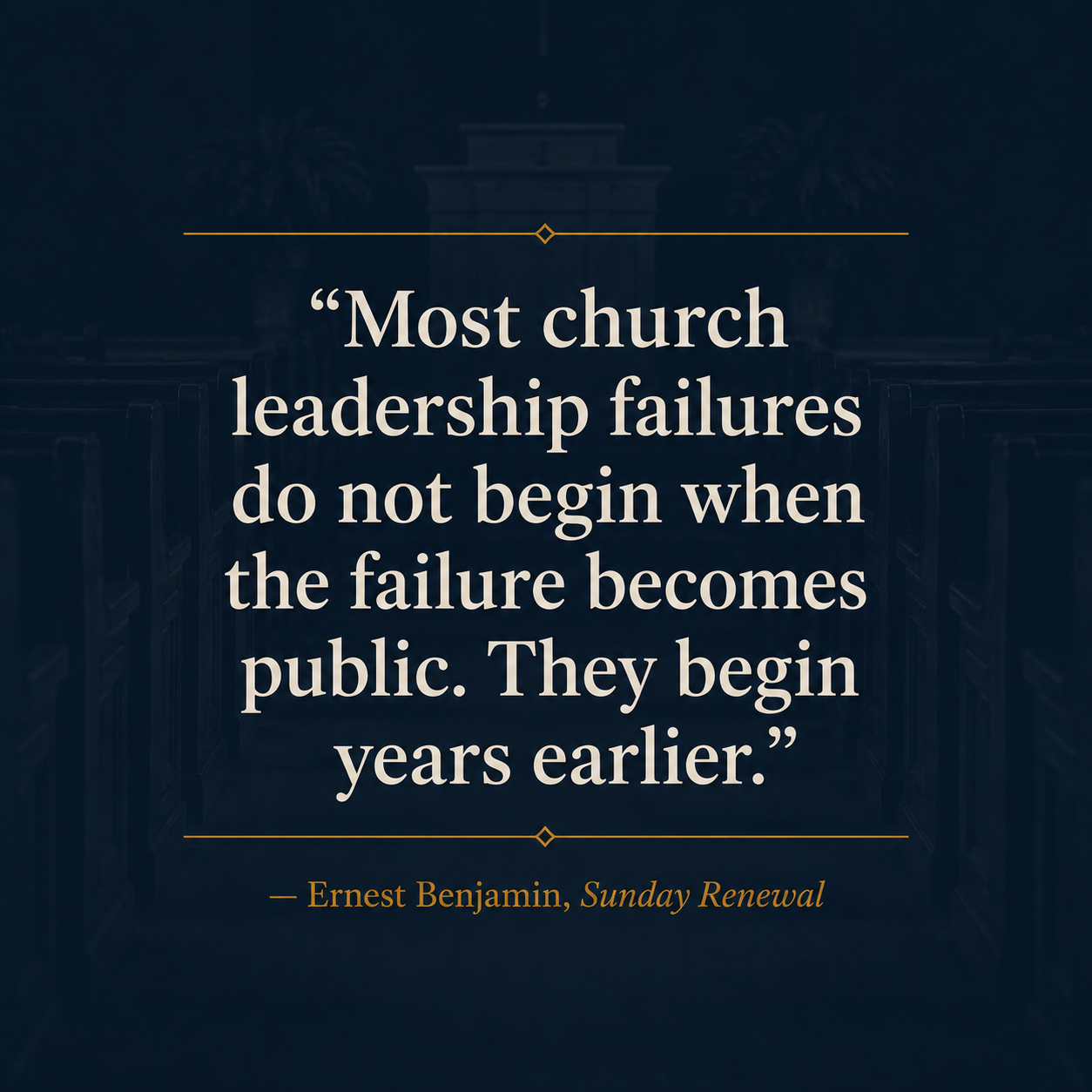
Most church leadership failures do not begin the day they become public.
The scandal that eventually splits a congregation. The pattern of sin that finally comes to light after a decade of quiet damage. The leader whose downfall shocks everyone except the handful of people who saw it coming years before anyone else would say it out loud.
In almost every case, the failure the world eventually sees is only the fruit. The root was planted long before.
Sometimes the root was a rushed appointment, a man placed in leadership before he was ready, because the church needed someone, and it needed them now. Sometimes the root was an ignored warning sign, a quiet pattern a few people noticed but no one wanted to raise. Sometimes it was untested character, impressive gifts on full display, but a man who had never been tried in the unseen places where real maturity is actually formed. And sometimes the root was simply misplaced confidence, a church that wanted someone in the position so badly it stopped asking whether the man was actually ready.
When a bridge collapses, investigators don't just ask what happened today. They ask what was overlooked years ago. What flaw was missed in the original construction? What warning sign was ignored during a routine inspection? What corrective action could have prevented the catastrophe before it ever happened?
Paul asks the church the same kind of question. And in the final verse of 1 Timothy 5, he gives us one of the most practical, urgent, and quietly underused warnings in the entire New Testament.
The Question Underneath Your Cynicism
If you've walked with the church for any length of time, there's a question you're probably carrying, one you may not have said out loud even to yourself.
Is the church I love going to make the same mistakes all over again? Will the next generation grow up watching another wave of leadership failures? Is there any reason to believe this can actually change?
If you've grown deeply distrustful of church leadership altogether, hear this: the question underneath your cynicism is the very question Paul answers in this verse. Could this have been prevented? His answer, more often than we want to admit, is yes.
This is the final message in a multi-part series called The Stewardship of Church Leadership, and the thread running through all these weeks is the same: Christ protects His church when His people steward leadership according to His design.
Week one gave us honor. Weeks two and three gave us accountability. This week, Paul takes us one step further...from reactive stewardship to preventive stewardship. From what to do when leaders fail, to how to keep many of those failures from ever beginning.
Here is the sober truth many congregations have only learned after years of pain: most leadership failures that have wounded the church in our lifetime could have been prevented at the front end — if someone had been willing to slow down, ask hard questions, and refuse to lay hands on a man before he was actually ready.
What "Laying On of Hands" Actually Means
The text is short, 1 Timothy 5:22, but it carries the weight of nearly every leadership wound the church has ever endured, and the wisdom to prevent many more.
"Do not be hasty in the laying on of hands." — 1 Timothy 5:22 (ESV)
The New Living Translation renders it, "Never be in a hurry about appointing a church leader." The Holman Christian Standard is even more direct: "Don't be too quick to appoint anyone as an elder." Whatever the translation, the meaning is unmistakable — this is a command about appointing church leaders, and Paul's instruction is simple: never rush it.
"Laying on of hands" shows up in two distinct ways in the New Testament. In some passages, it was the means by which the apostles imparted the Holy Spirit to early believers, a unique, foundation-era apostolic function (Acts 8:17; 19:6). But the sense Paul means here in 1 Timothy 5:22 is different. It's the way the early church publicly recognized, affirmed, and appointed men to spiritual responsibility: the moment a congregation said, we have evaluated this man, we have prayed over him, we have weighed his qualifications, and we are now formally entrusting him with spiritual responsibility before God and before this congregation.
That's the moment Paul is protecting. And his instruction for that moment is one word: don't rush it.

The Pressure Paul Is Speaking Into
The Greek word behind "hasty" means quickly, currently, without sufficient time taken. Paul isn't telling Timothy to refuse to appoint leaders, or to set the bar impossibly high. He's telling him one thing — do not rush. And that may be one of the most countercultural commands in the New Testament for how the modern church actually operates.
Because if we're honest, the pressure most congregations feel isn't the pressure to slow down. It's the pressure to fill the position. We need a preacher. We need another elder. We need a deacon. We need someone to lead this ministry, and we need them now. Under that pressure, churches make appointments they later regret. They lower the standard. They look past warning signs. They tell themselves he's gifted when the deeper question has always been: is he ready? They confuse the availability of a man with the readiness of a man, and by the time the consequences show up, sometimes years later, the cost has already become enormous.
Paul saw this pressure coming. That's exactly why he wrote the verse.
Fruit Ripens Before It's Harvested
Real evaluation takes time. Time to observe a man's character across multiple seasons of life. Time to watch how he handles success and disappointment. Time to see whether his private walk matches his public reputation. Time to see whether the men who would be his peers actually respect him.
It also takes real, careful evaluation against the qualifications Paul laid out just two chapters earlier — above reproach, faithful in marriage, sober-minded, self-controlled, respectable, hospitable, able to teach, not a drunkard, not violent, gentle, not quarrelsome, not a lover of money, managing his own household well, not a recent convert, well thought of by outsiders (1 Timothy 3:1–13). That list isn't a suggestion. It's the standard, and "the laying on of hands" is the moment a church formally affirms a man has met it, not in theory, but in demonstrated, tested character.
Here's an image worth sitting with:
Fruit ripens before it's harvested. A farmer who picks fruit too early ruins it; the skin tears, the flavor never develops. What could have become a sweet, mature harvest becomes a wasted crop, picked too soon, too eager, too rushed. The fruit wasn't the problem. The timing was.
The man who could have been a faithful elder in five years, given time to grow, to be tested, to demonstrate character in the unseen places, can be appointed too early and ruined. Not because he was a bad man, but because he was placed under a weight he wasn't ready to carry. His immaturity got exposed faster than his character could mature to meet it. And the church paid the price right alongside him.
This is one of the great unspoken tragedies of modern church leadership: we have ruined men by promoting them too soon. We have damaged churches by appointing leaders who needed five more years of quiet formation before they were ready to stand at the front of the room.

An Honest Caveat
Careful selection is not a guarantee. The most discerning eldership in the world cannot prevent every future leadership failure. Hearts can drift. Men can change. A man who genuinely meets every qualification today can, through the slow erosion of unchecked sin, an untended marriage, or unattended prayer, drift years down the road.
Paul isn't promising perfect leaders. He's teaching that careful selection greatly reduces the risk and honors what God has commanded. The goal was never perfection. The goal is faithfulness.
Four Groups, One Word: Slow Down
To the congregation: Do you value character more than charisma? When Samuel looked at Jesse's sons, he saw the tall, impressive Eliab and thought, surely this is the Lord's anointed. But God corrected him: "Do not look on his appearance or on the height of his stature… for the Lord sees not as man sees. Man looks on the outward appearance, but the Lord looks on the heart" (1 Samuel 16:7, ESV). That's the divine corrective to every appointment culture that elevates the gifted over the godly.
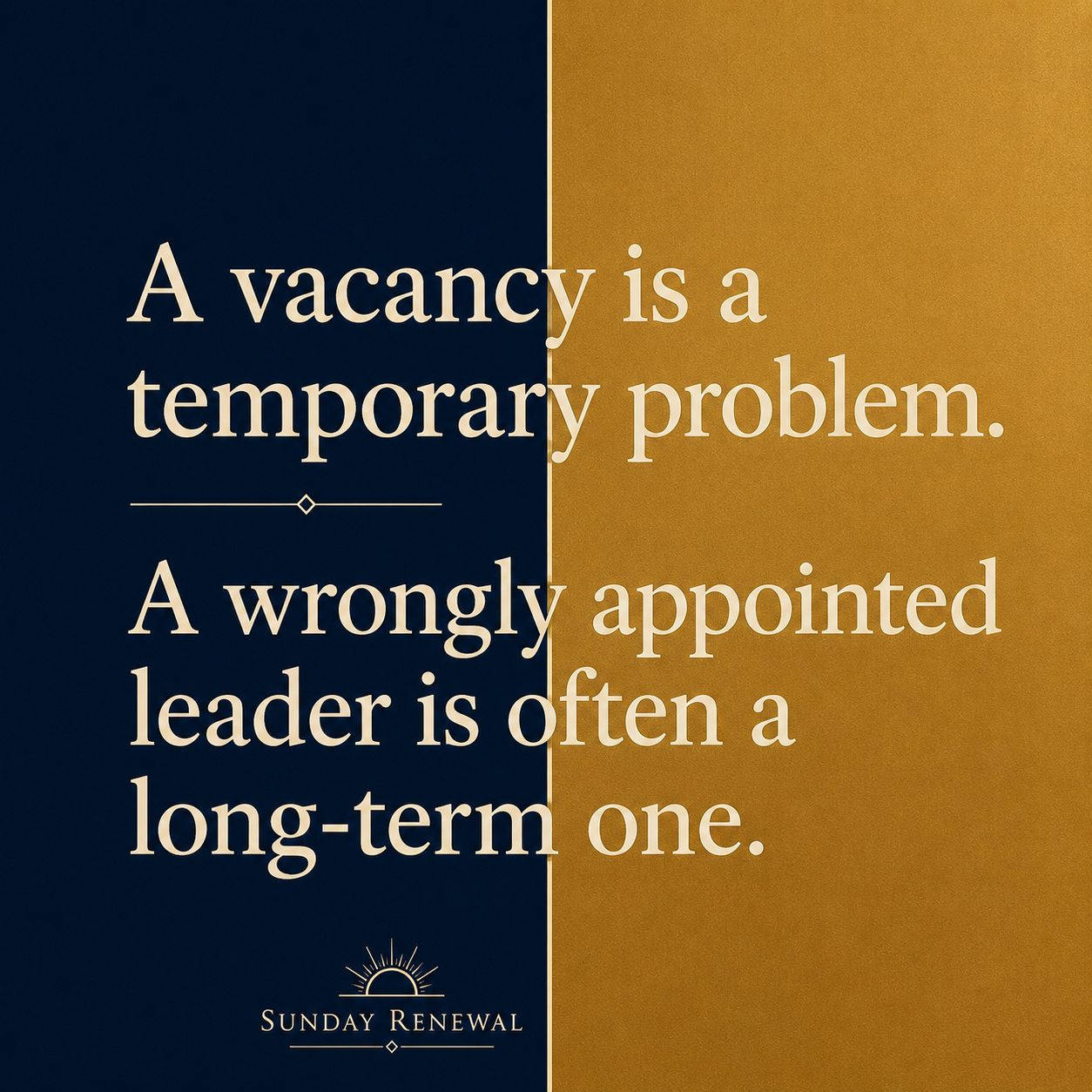
To current leaders: Do not lower the standard because of an immediate need. Proverbs 21:5 has been saying this for three thousand years — "The plans of the diligent surely lead to advantage, but everyone who is hasty surely comes to poverty." A vacancy is a temporary problem. A wrongly appointed leader is often a long-term one.
To future leaders: Do not seek the position before you've pursued the character. Do not lobby for appointment or measure your readiness by the strength of your gifts rather than the depth of your character. When James and John came asking for the seats of honor, Jesus redefined greatness for His kingdom forever: "Whoever would be great among you must be your servant… for even the Son of Man came not to be served but to serve" (Mark 10:43–45).
To parents: The next generation of faithful shepherds isn't appointed from nowhere...it's formed. And formation begins at the kitchen table, long before anyone considers a title. The young man who may one day be entrusted with Christ's flock is right now watching how his father handles disappointment and whether the gospel preached on Sunday is the same gospel lived on Monday.

God's Timetable Is Slower Than Ours
The God who set the seasons, who let a seed germinate underground for months before it ever breaks the soil, who took eighty years to prepare Moses, who let David shepherd sheep for years before the throne, who let His own Son live in obscurity for thirty years before three years of public ministry...this is not a God in a hurry to develop leaders.
And the church that rushes what God does not rush is the church that often pays the cost later for what patience would have prevented.
Value character before charisma. Trust the Lord's timetable. Refuse the pressure to rush what God Himself is taking His time to form.

This post is part of the Sunday Renewal series: The Stewardship of Church Leadership.
Ernest Benjamin is the host of Sunday Renewal, a podcast and discipleship ministry helping spiritually exhausted believers reconnect with God through biblical truth, emotional honesty, and gospel-centered transformation. New episodes release every Sunday. Subscribe on Apple Podcasts, Spotify, or YouTube.
Before you go, if you're in a season of spiritual exhaustion, discouragement, or searching for a fresh start, the free 5-day audio devotional Renaming Your Story: From Pain to Purpose to Legacy was created for exactly where you are.
Love This Content? Help Us Share More Hope & Faith! 💛
Join Me Weekly:
Subscribe to my blog for fresh devotionals that bring God’s Word to life, listen to the weekly podcast, or follow me: